

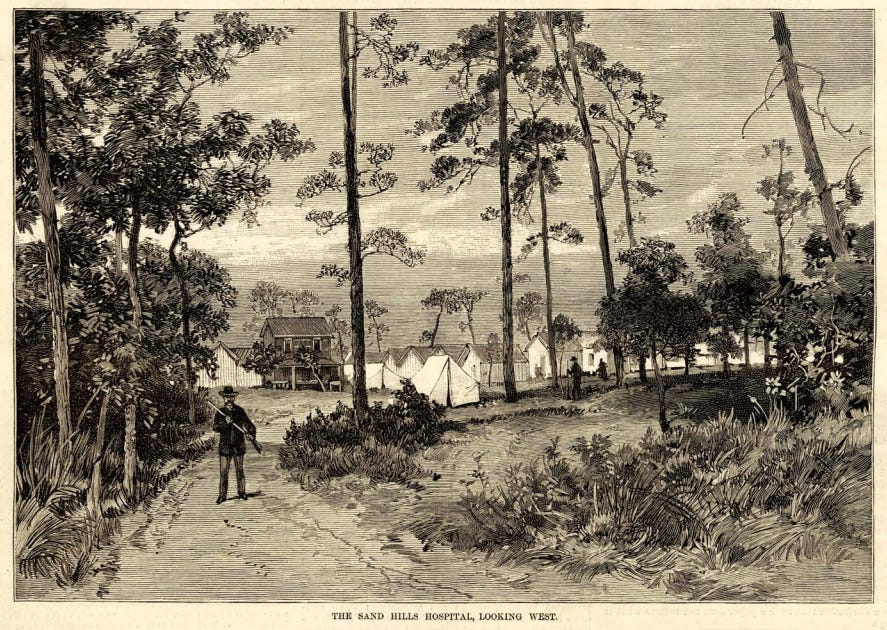
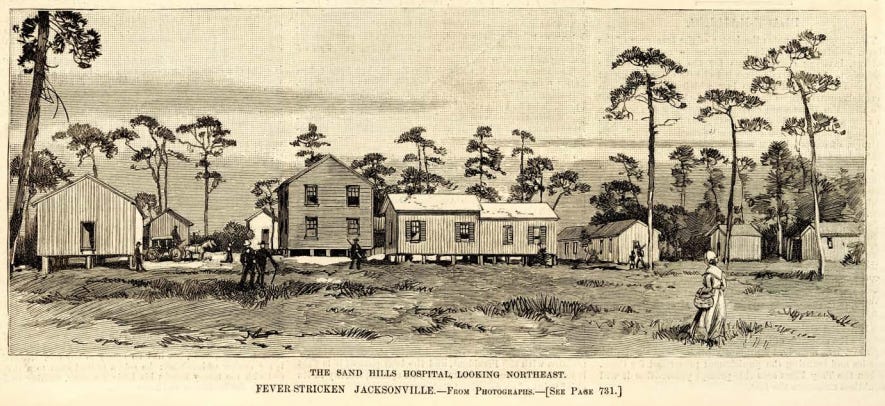
The history of the Norwood neighborhood is uniquely intertwined with Jacksonville’s medical past, mirroring the legacy of the school’s namesake, Dr. John Kirk Norwood. Long before the area was platted for residential use, it served a grim but essential public health function as the site of Sand Hills Hospital, a “pest house” established around 1883 to isolate patients with contagious diseases like smallpox.
During the catastrophic yellow fever outbreak of 1888, this facility became the city’s front line of defense, housing victims like Richard D. McCormack under the care of Dr. Sollace Mitchell.
During the summer of 1888, a devastating yellow fever outbreak paralyzed Jacksonville, crippling the local economy and claiming 427 lives. Long before Norwood was platted, it became the site of a “pest house” known as Sand Hills Hospital. Historical details regarding the Sand Hills Hospital are scarce, leaving its origins and ultimate fate largely undocumented. It’s believed the hospital was constructed around 1883 in response to a rash of smallpox cases in the city and was later expanded to house those infected with yellow fever.
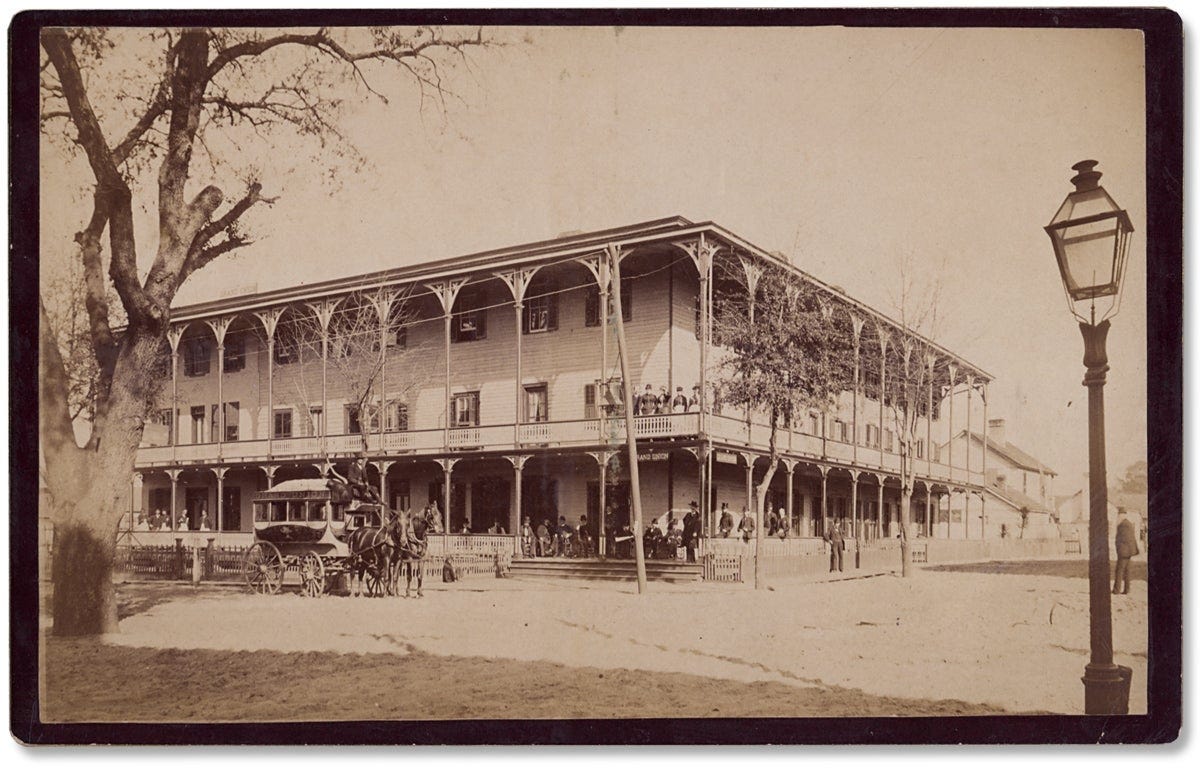
The first confirmed case of the disease in Jacksonville was Richard D. McCormick, a Tampa "saloonkeeper and otherwise disreputable person," who violated the quarantine set up there and arrived via train. He checked into the Grand Union Hotel and was reported for his suspicious symptoms to the president of the local board of health, Dr. Neall Mitchell. On June 29, 1888, Mitchell diagnosed McCormick with yellow fever and "was promptly sent to the pest house” at Sand Hills, where his brother, Dr. Sollace Mitchell, became the resident physician.
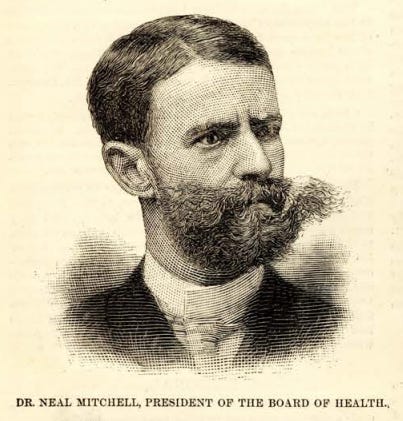
Reporting on the incident, The Times asserted that McCormick's actions had "willfully endangered" the entire state of Florida, and The New York Times declared that it was “every one for himself” in Jacksonville, as panic quickly spread along with the disease.
Public alarm centered on the Mayflower House restaurant, following several reports of illness, and deemed the epicenter of an outbreak of yellow fever on the east side of the city. By August 8, the building was condemned and incinerated. As for the Grand Union Hotel, ground zero of the outbreak, it would stay open, although anyone inside at the time of the outbreak remained imprisoned in their rooms.
An investigation by the Board of Health found that the conditions at the Grand Union Hotel were terrible to say the least. A judge ordered that those locked up be moved, the building disinfected, and it be boarded up and closed until further notice.
To many, this wasn’t enough, and wished the building destroyed. Miles Price Jr., son of the founder of the Brooklyn neighborhood on the west side of the city, Miles Price, owned the Grand Union Hotel, having inherited it after his father’s passing. He wrote to The Times-Union, “The Grand Union Hotel has been depopulated, fumigated, and threatened with fire, and is now under guard. This is my property.”
The Time-Union wrote, “The Grand Union Hotel has been the first house to entertain the yellow fever on its advent in Jacksonville on the occasion of every visit it has made during the past forty years, in 1957, in 1877, and in 1888. The Mayflower House was condemned for a much less degree of guilt.”
His arrogance eventually caught up to him, and less than a year later, Miles Price Jr. was killed by one of his mill workers, James Y. Coleman. According to Coleman, Price owed him money but refused to pay. During a heated argument, Coleman claimed Price slapped his face and kicked him. He responded by retrieving his pistol from his sleeping quarters and firing at Price, with the lead ball passing through his leg. Wounded, Price picked up a piece of iron and advanced on Coleman, when he was shot a second time in the gut. There was no attempt to arrest Coleman as he got on his horse and rode away.
Price was placed on a train and brought to the Grand Union Hotel, where he was put under the care of Dr. P. J. Stollenwerck, with Dr. Sollace Mitchell as a consultant. On July 17, 1889, The Florida Times-Union published an article regarding the incident and reported that “the wounded man was resting quietly, and being a strong, stout man, may have escaped a fatal injury.” The same day that the article was published, Miles Price Jr. died from his wounds.
Residents fled by any means possible, be it train, boat, or wagon, only to find themselves trapped by regional blockades. Cities across Florida and the Southeast, such as Mobile and Charleston, had effectively sealed their borders against Jacksonville travelers, going as far as threatening many of these refugees at gunpoint, dubbed "shotgun quarantines."
Many of these refugees were sent to quarantine camps located in the heavy pinewoods outside of Jacksonville city limits. It was even suggested that any persons coming to the city "having no business" being there should be arrested and sent to Sand Hills, where they would be fed nothing but bread and water. The grounds were patrolled by armed guards and packed with tents, giving it the appearance of an Army garrison rather than a hospital. Due to its reputation as a “pest house” and stories circulating among the public about the inhumane conditions inside the hospital, those who fell ill took their chances in their homes.
Despite the negative public perception of Sand Hills Hospital, it was likely the best place to receive treatment, given the circumstances. R. D. McCormick, the man who brought the plague to Jacksonville, actually survived his stint at Sand Hills, along with both his wife and brother. McCormick reportedly said that “the fear which many persons have og going to Sand Hills Hospital is entirely without reason, as the place is high, dry, and reasonably comfortable; the air is pure, patients are provided with comfortable beds and the best fare and attention.” At the time of his release, no deaths had occurred at the hospital.
One of the lesser-known figures who inadvertently prevented further infection at Sand Hills was Jenny Delano, who traded her position as New York’s Bellevue Hospital for the role of head nurse at Sand Hills. While many in Jacksonville had grown desensitized to the swarming insects, Delano insisted on covering the hospital windows with screens. Though the link between mosquitoes and Yellow Fever remained undiscovered, her demand for protection against these “pests” inadvertently targeted the very vectors of the disease.
She was described as “a young lady of about twenty-five, very attractive in person and manner, an admirable disciplinarian, yet sympathetic, refined, and intelligent, and wins the hearts of all with whom she comes in contact.”
As the hospital filled up, deaths were bound to occur. Those claimed by "Yellow Jack" were often interred at the Sand Hills cemetery, while others were transported to the city’s Evergreen Cemetery. The traffic at Evergreen grew so relentless that the constant passage of funeral wagons eventually forced the city to repair the battered roads leading to its gates.
At the time, it wasn’t known how yellow fever was transmitted, but the widely believed theory was that miasma, “bad air” from decaying matter, was the culprit. As far back as 1881, though, Cuban doctor Carlos Finlay theorized that yellow fever was spread through mosquitoes, but he was roundly mocked and ridiculed for this. So to combat this “bad air” and purify it, pine, sulfur, and tar were burned in the streets of Jacksonville, and guns were fired into the air, thinking the germs could be destroyed by ‘concussion’.
Almost as fast as Yellow Jack had come, it left as the cold rolled in during the winter, putting all the carriers of the disease into a dormant state. As the hospital was only operational during emergencies and outbreaks of smallpox and yellow fever, it closed on November 12, 1888.
In the following years, the buildings would fall into disrepair, but would be used in the early 1900s during an outbreak of smallpox among the Black community. It wasn’t until white patients began being admitted that the buildings were repaired and upgraded.
The site would later temporarily serve as a prison farm before Sand Hills seemingly disappeared from history around 1917, when the property was repurposed for use as the state fair. As for the lost souls buried there, some locals recount bones being dug up during the construction of the Gateway Mall; the whereabouts of those bones are unknown.